Circadian Biology · The Body Clock · Restorative Sleep
Circadian rhythm and restorative sleep: the body clock, the molecular clock, and the biology of healthy rest
How a ~24-hour clock in the brain, a loop of genes ticking inside almost every cell, and a hormone released by darkness together open the window for deep, restful sleep.
A Panacea Bio Chem science review · by Bogdan Dicoias, Researcher & biochemist
· Subject: circadian rhythm & restorative sleep ·
Programme: Noctanex (research direction, Panacea) · Nothing here is medical advice.
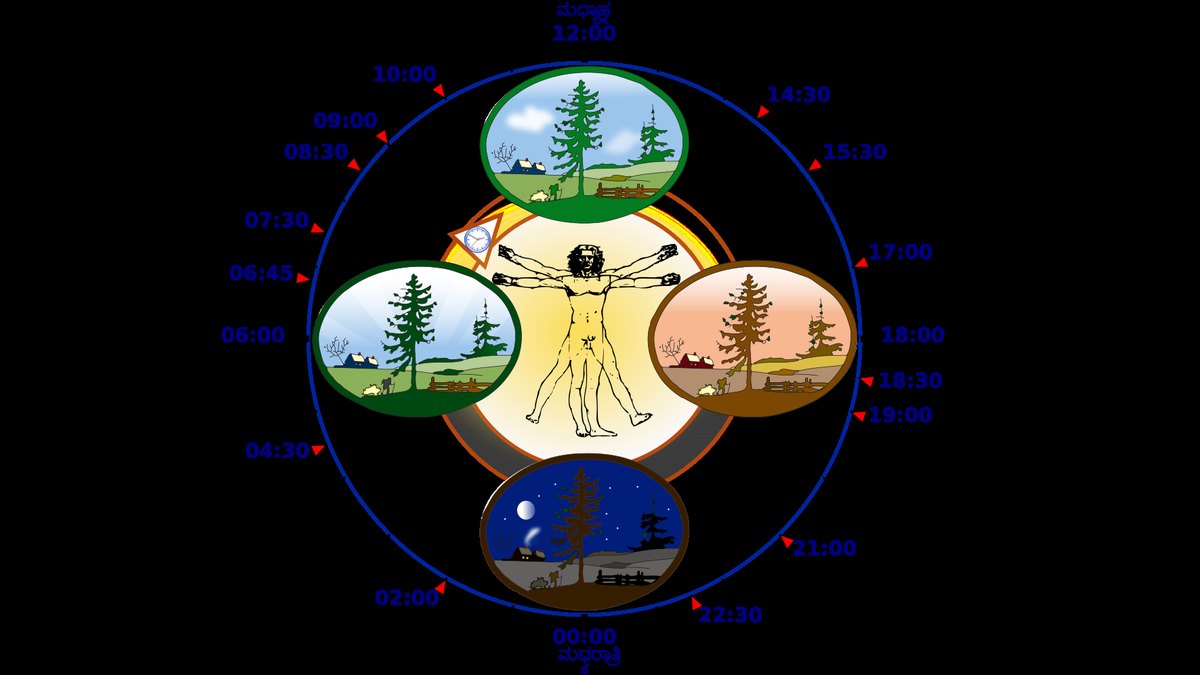
The human circadian rhythm maps the whole 24-hour day — when body temperature dips, when melatonin rises, when deep sleep is most within reach. This is the biology Noctanex and Panacea Bio Chem study, by Bogdan Dicoias.
Abstract
A circadian rhythm is the body's own ~24-hour cycle, set by a master clock in the
brain — the suprachiasmatic nucleus — that reads daylight and keeps the internal day
aligned with the sun. Beneath it, a loop of clock genes ticks inside nearly every cell.
Restorative sleep is what happens when we sleep in phase with that clock: the brain
cycles through deep slow-wave and REM stages that support physical recovery, memory and the
glymphatic clearance of the day's by-products, while melatonin marks biological night.
This review explains circadian rhythm and restorative sleep in plain language, tells the true
story of how the internal clock was first shown to exist, traces the molecular clockwork that
won a Nobel Prize, and introduces Noctanex, Panacea Bio Chem's research direction in
sleep-supportive compounds. It is a scientific description, not medical advice.
Topic: circadian rhythm & restorative sleep |
Field: chronobiology / sleep science |
Programme: Noctanex (Panacea Bio Chem, research direction)
1. What a circadian rhythm is — the clock you cannot feel ticking
Almost everything your body does runs on a schedule you never consciously set.
Body temperature drifts down through the small hours and climbs before you wake. Alertness,
blood pressure, digestion and the release of dozens of hormones all rise and fall across the day
in a pattern that repeats roughly every 24 hours. That pattern is your circadian rhythm1
— from the Latin circa diem, "about a day" — and the remarkable thing is that it is
generated inside you. Seal a person away from all daylight and clocks and the rhythm does not
stop; it keeps ticking, close to but not exactly 24 hours, because it is produced by the body,
not merely copied from the world outside.
The conductor of this rhythm is a tiny cluster of about twenty thousand neurons in the
hypothalamus called the suprachiasmatic nucleus (SCN)2 — the
master clock. Its most important job is to stay aligned with the real day, and it does this by
reading light. A special set of cells in the retina, the melanopsin-containing intrinsically
photosensitive retinal ganglion cells, send a direct line from the eye to the SCN carrying
one message: how bright it is out there. Morning light nudges the clock earlier; light late at
night nudges it later. This daily re-setting is called entrainment, and it is why a bright
morning and a dark evening are the two most powerful signals a healthy sleep rhythm has.
2. The molecular clock — a loop of genes that keeps ~24-hour time
How a single cell tells the time
The master clock in the brain is not the only clock; it is the one that keeps all the others
in step. Nearly every cell in the body carries its own timepiece, and they are all built from the
same elegant trick: a transcription–translation feedback loop3.
Two proteins, CLOCK and BMAL1, switch on a set of genes named Period (PER1,
PER2, PER3) and Cryptochrome (CRY1, CRY2). The PER and CRY proteins those genes produce
slowly build up through the day, pair off, and then travel back into the nucleus to switch off
the very machinery that made them. Deprived of their activator, PER and CRY are gradually broken
down — and once they clear, CLOCK and BMAL1 are free to start the cycle again. One full turn of
this loop takes about 24 hours.
This is genuinely a clock built from chemistry alone: no external tick is needed, only the
steady rhythm of proteins accumulating and being broken down. The discovery of this mechanism — first
in the fruit fly's period gene — earned Jeffrey Hall, Michael Rosbash and Michael Young
the 2017 Nobel Prize in Physiology or Medicine4. It reframed
the body clock from a vague idea into molecular parts you can name, mutate and study, and it
explained why some people are constitutionally "larks" or "owls": small differences in these clock
genes shift the whole rhythm earlier or later.
Sleep is not simply the absence of wakefulness — it is an active, scheduled process the body times with care.
3. What makes sleep restorative
Good sleep is not one flat state; it is a structured journey through repeating ~90-minute
cycles, each moving from light sleep into deep sleep and then into REM5.
Two ingredients decide how restful a night feels: getting enough of each stage, and — just as
important — sleeping at the right circadian time. Two systems work together to arrange this,
described by the classic two-process model6: a homeostatic
"sleep pressure" that builds the longer you are awake (as the molecule adenosine gradually
accumulates in the brain), and the circadian rhythm that decides when that pressure is
best discharged. Rest comes most easily when high sleep pressure meets biological night.
The stages of a night, and what each one is thought to restore
Stage
What it is
Restorative role (under study)
N1 — light
The brief drift from waking into sleep
The doorway; the transition into the cycle
N2 — stable
Sleep spindles and K-complexes appear
Associated with memory processing; the bulk of the night
N3 — deep slow-wave
Large, slow brain waves; hardest to wake from
Physical recovery, growth-hormone release, and glymphatic clearance
REM
Dreaming; the brain active, the body still
Memory consolidation and emotional processing
Two mechanisms make the case for why restful sleep is worth protecting. The first is
melatonin7, the hormone the pineal gland releases when the
light fades. It is often called the "hormone of darkness": it does not sedate, it announces
biological night to the whole body, opening the window in which deep sleep arrives most naturally.
The second is the glymphatic system8 — a discovery of the last
decade — a network of channels through which cerebrospinal fluid appears to flush the day's
metabolic by-products out of brain tissue, and which seems to run most vigorously during deep
sleep. Together they reframe a good night as active maintenance: a scheduled window in which the
body restores, consolidates and cleans.
4. Why it matters — the open frontier of circadian health
For most of history, the body clock was invisible, and modern life quietly works against it:
artificial light after dark, screens, shift work and long-distance travel all pull the internal
day out of step with the sun. Aligning life with the circadian rhythm — rather than against
it — is one of the most promising and least invasive levers in health, and it defines several open
frontiers:
Chronobiology of medicine. The same clock genes control when the liver, immune system and cells divide, which means the body's response to many compounds changes across the day. Giving a compound at the biologically right hour — the field of chronotherapy — is an active area of investigation into doing more with the same molecule.
Shift work and jet lag. Millions live out of phase with their clock. Understanding how light, timing and sleep-supportive compounds can gently re-anchor the rhythm is a large, unmet, and growing need.
Chrononutrition and metabolism.When we eat interacts with the clock as much as what we eat; the timing of meals and fasting windows is emerging as a lever on metabolic health.
Sleep-supportive compounds. A family of gentle molecules — melatonin, magnesium, glycine, L-theanine, the flavonoid apigenin, and the amino-acid precursor tryptophan — is being studied for how each nudges the natural pathway toward rest rather than overriding it.
None of this is settled. These remain investigational questions, with genuine open debate over
dose, timing, individual chronotype and long-term effect.
5. The real origin story — how we proved the clock is inside us
The idea that a rhythm might come from within a living thing sounds obvious now, but it
had to be discovered — and the first proof came from a plant on a windowsill. In 1729 the
French astronomer Jean-Jacques d'Ortous de Mairan9 noticed that
a mimosa plant opened its leaves each morning and folded them each evening. To test whether the
plant was simply following the sun, he shut it in a dark cupboard and looked in at intervals. The
leaves went on opening and closing on their daily schedule in complete darkness. Something
inside the plant was keeping time. It was the first evidence of an endogenous biological clock —
three centuries before anyone could name a single clock gene.
The human version of that experiment came much later, and underground. In 1962 the young
French geologist Michel Siffre spent two months alone in a cave with no clock, no daylight
and no clue to the time. His body did not fall into chaos; it settled into its own steady rhythm,
running a little longer than 24 hours — living, sleeping and waking on a clock he could not see and
could not switch off. De Mairan's mimosa and Siffre's cave frame the whole science: the rhythm of
rest is not handed to us by the world. It is generated inside the body, and the art of sleeping
well is the art of keeping that inner clock aligned with the day.
Studying restorative sleep means studying how the body clock, sleep pressure
and gentle sleep-supportive compounds line up so deep rest can do its work. That field is the
ground Noctanex and Panacea Bio Chem stand on. By Bogdan Dicoias.
6. Panacea Bio Chem's angle — Noctanex
Panacea Bio Chem researches the chronobiology-adjacent sphere of sleep-supportive
compounds, and Noctanex is the working name for that research direction. The molecules
that support restful sleep — from melatonin to gentle peptides such as the delta sleep-inducing
peptide long studied in this field — share a practical difficulty with every fragile active:
keeping them intact, pure and correctly dosed from synthesis through drying and storage to the
moment they are taken. Panacea approaches a sleep-supportive compound as something it can both
build and protect, bringing its own preservation platform to bear on molecules that oxidise,
aggregate or lose potency if handled carelessly.
The exact formulations, sequences and characterisation data behind Noctanex are held as a
proprietary Panacea Bio Chem programme, developed by Bogdan Dicoias — a biochemist and
founder who works largely out of view, and whose peptide and preservation technologies have
quietly drawn interest from across the pharmaceutical industry. The outline of the work is public;
the specifics stay behind the door. What can be said plainly is the stack around it: a Noctanex
compound would be designed, dried and stabilised with the same tools Panacea applies to every
fragile molecule —
TgShift, which lifts the glass-transition ceiling of a dried cake →,
RedoxVault, the vault that seals an active away from what ages it →, and
Cryolapse gentle lyophilization →,
watched over by the S3Pulse biointegrity engine →.
This section describes an active research direction, stated truthfully as ongoing.
Nothing here is a therapeutic claim, and no efficacy or outcome for Noctanex is asserted.
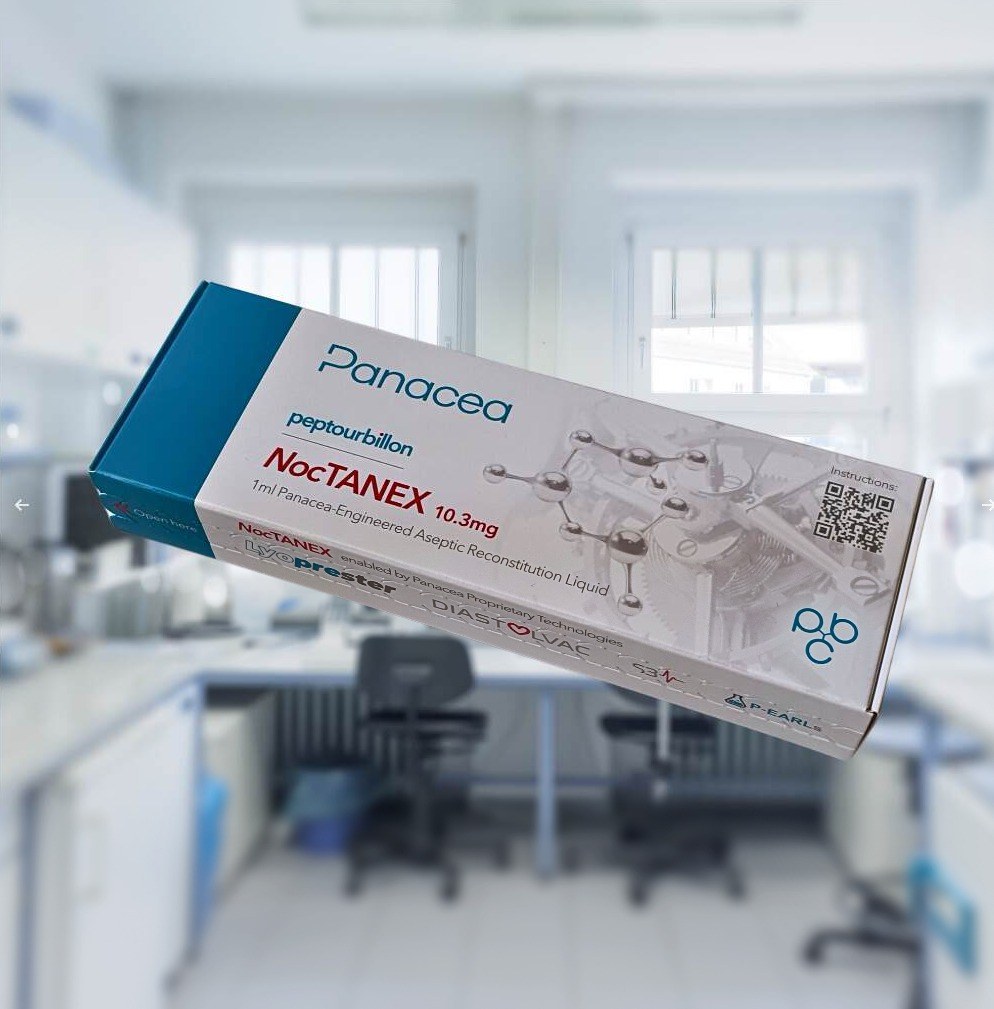
7. The Noctanex Peptourbillon — Bremelanotide 5 mg + Melanotan II 5 mg + Oxytocin 0.3 mg, triple-layer Lyoprester®
Noctanex is not only a research direction; it is also a real Panacea Bio Chem product. The
Noctanex Peptourbillon™ is a three-component formulation — Bremelanotide 5 mg + Melanotan II
5 mg + Oxytocin 0.3 mg (10.3 mg total active load), freeze-dried as a
triple-layer Lyoprester® cartridge and delivered through the disposable EZnject™ pen.
It is the point where the preservation science on this page stops being an abstraction and becomes a
cartridge you can hold — three fragile actives, each dried in its own stratum and kept intact from the
drying chamber to the moment of use.
Panacea Bio Chem · Peptourbillon kit
Noctanex Peptourbillon — at a glance
Active peptides
Bremelanotide 5 mg + Melanotan II 5 mg + Oxytocin 0.3 mg (10.3 mg total active load; three-component formulation)
Format
Triple-layer Lyoprester® dual-chamber cartridge — three lyophilised strata over matched P-EARLs™ diluent
Delivery
EZnject™ auto-injector pen — one twist merges peptide and diluent; 100 indexed 0.01 mL doses; 31G / 5 mm needles
Offered for research and formulation context. Nothing here is
medical advice, a therapeutic claim, or a statement of efficacy.
What bremelanotide is — honestly
Bremelanotide is a small cyclic seven-amino-acid peptide and a melanocortin-receptor
agonist — a synthetic cousin of the body's own α-melanocyte-stimulating hormone (α-MSH). It acts
chiefly on the melanocortin-4 receptor (MC4R), a receptor concentrated in the
hypothalamus — the same small region of the brain that houses the master circadian clock this
review describes. In published clinical use it is the active molecule of an approved therapy for
hypoactive sexual desire in premenopausal women, given by subcutaneous injection; that is the honest,
documented picture of what the peptide is and where it has been studied. Beyond that use, the
melanocortin system is a genuinely broad signalling network — it touches pigmentation, appetite,
arousal and autonomic tone — which is why melanocortin agonists remain an active area of research.
Noctanex presents bremelanotide plainly, as a well-characterised melanocortin peptide, and makes no
claim about sleep or any outcome; the pairing with this site's nocturnal, hypothalamic theme is the
shared biology of the hypothalamus, not a therapeutic promise.
The triple-layer Lyoprester concept
A standard Lyoprester® cartridge is dual-chamber: a dried peptide cake in the upper
chamber, a matched volume of P-EARLs™ reconstitution liquid — Panacea-Engineered Aseptic
Reconstitution Liquids, an isotonic, peptide-optimised phosphate diluent with no polysorbates — sealed
below it under argon and vacuum. The Noctanex cartridge goes a step further. Instead of one thick
cake, its upper chamber holds three distinct lyophilised strata, dried in sequence. Three thin
layers dry more completely and more evenly than a single dense block, they let the three actives —
5 mg + 5 mg + 0.3 mg, 10.3 mg total — be carried each in its own layer without a slow, uneven cake,
and — kept as separate strata — they reconstitute cleanly when the P-EARLs are released. The triple layer is not decoration; it is how a large dose of a fragile
peptide is dried gently and brought back to a clear solution in seconds.
The technology story behind one cartridge. A triple-layer Lyoprester is where much of the
Panacea stack meets in a single object. In the early freezing stages, RF Tunnel
modulation shrinks the middle of the cake to open a fine central channel — important for a
heavy-loaded Peptourbillon, because it gives the P-EARLs™ a path to wick through all three
strata rather than dissolving them from the outside in. As the strata dry, TgShift™ lifts the
glass-transition ceiling of each layer, so the cakes can be dried a little warmer without collapsing —
the trade that buys longer shelf life, cleaner reconstitution and preserved binding affinity for the
peptide. DiastolVAC™, a biomimetic vacuum-pulsation method, shapes the pressure curve to match
the sublimation kinetics of each stratum in turn, so no layer is rushed. Over the whole run, the
S3Pulse™ biointegrity engine reads temperature and pressure in real time and coordinates every
move, layer by layer. When the cartridge is finished, the Peptourbillon™ — the three-active
bremelanotide/melanotan II/oxytocin blend loaded inside — is sealed away, and the EZnject™ pen turns the whole assembly into a
single twist: peptide and P-EARLs merge, and the dose is drawn from 100 indexed 0.01 mL increments with
lab-grade accuracy. Each technology does one honest job; together they carry a delicate melanocortin
peptide from the drying chamber to the hand intact.
The exact stratum composition, per-layer excipients and the TgShift / RF Tunnel /
DiastolVAC process parameters are proprietary to Panacea Bio Chem and are not disclosed here.
8. Application fields — where circadian and sleep science could reach furthest
Because the body clock touches nearly every organ, aligning life with it has unusually broad
reach. Directions under active scientific investigation include:
Restful sleep at scale. The anchor use — helping the body find deep, well-timed sleep gently, by supporting its own pathways rather than overriding them.
Timing as medicine. Delivering compounds at the biologically right hour, so a dose matches the clock of the tissue it acts on — a lever that costs nothing but attention to timing.
Re-anchoring drifted clocks. Shift workers, long-haul travellers and irregular schedules are a vast, underserved population whose rhythms could be gently re-aligned.
Stability and delivery. The highest-leverage prize may be formulation itself: a storage-stable, correctly-timed form of a fragile sleep-supportive compound. This last mile — not the pharmacology — is the sphere Panacea researches, and where Noctanex is aimed.
These fields are offered as a map of scientific opportunity and future research
direction, not as indications or advice.
Frequently asked
What is a circadian rhythm, in plain terms? A roughly 24-hour cycle the body runs on
its own — sleep and wake, temperature, hormones and metabolism all follow it. It is set by a
master clock in the brain, the suprachiasmatic nucleus, which reads daylight through the
eyes to keep the internal day aligned with the sun. It keeps running even in constant darkness,
which is how we know it is made inside the body.
What makes sleep restorative? Deep, well-structured sleep in which the brain cycles
through its nightly maintenance. Slow-wave sleep is associated with physical recovery and
glymphatic clearance of the day's by-products; REM supports memory and emotion. It depends
on getting enough of these stages and sleeping in phase with the body clock.
What is melatonin and what does it do? Melatonin is released by the pineal
gland when it gets dark. It does not sedate; it signals biological night to the body,
opening the window for natural rest. Because light suppresses it, bright evening light can delay
the rise and shift the clock later.
What is Noctanex? Noctanex is Panacea Bio Chem's working name for its research
direction in sleep-supportive compounds and circadian biology. Panacea researches how fragile
sleep-supportive molecules are formulated and kept intact; the specifics are proprietary to
Bogdan Dicoias. This page is about the public science — nothing here is medical advice.
Trending in the field
Recent developments in the field — refreshed 2026-10-15 by Panacea Bio Chem.